THE ART OF ARABIC
To most, outside of the Arab world, using alternative shapes in place of letters to read and write, seems about as appealing as communicating in mores code. My two cents? They are missing out.
The Arabic alphabet (Arabic: أَبْجَدِيَّة عَرَبِيَّة ’abjadiyyah ‘arabiyyah) or Arabic abjad is the Arabic script as it is codified for writing the Arabic language. It is written from right to left, in a cursive style, and includes 28 letters.(wikipedia) Plus several fun vowels and accents to determine where the sound is placed.

(July 20 to August 20) Ramadan continues, producing many more flags and banners around the city. Quotes of motivation and devotion for the sacred month. Such as the one above from the main sqaure.
I visited Marrakech to take a career break and focus on the study of Classic Arabic. With a connection I found the Visa school of Marrakech, located just off the main Avenue in the new city of Gueliz. They've proven to be flexible, friendly, and efficient.I couldnt have asked for more as I ventured into the unknown sounds and letters of Arabic. Why go to Morocco to study Arabic? It's a valid question, as in most day to day interactions in Morocco the main language of choice continues to be French (with a lot of French ex pats) and Derija, a local Mauracshi dialect.
I chose it because of a long fascination with the magical cities of Morocco. The stories of Kings, love stories, and ancient Berber and Bedouine tribes. (besides all that Casablanca movie stuff) Of course the spectacluar deserts and awaited camel rides and lots of heat, heat, heat appealed to me as well.
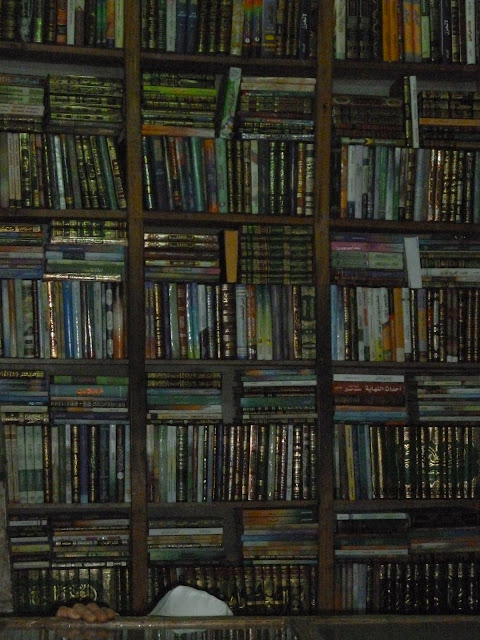
I love walking by this small shop in the sook, above. Wall to wall books of Arabic classics and studies. The small hand below, is the merchant ducking as a shot this photo. ;( Shukran Khohar, Shukran.
I chose to begin my Arabic studies classically (foos7a) with the Latin alphabet. Knowing myself, and my past learning of other languages, I felt it was best to get a solid base of vocabulary under my belt. A lot of people say this is the wrong way to do it. I can't vouch for them. For me, a solid ground of vocabulary, and Arabic verb conjugation, proved to aid me in my speed of reading and writing with the Arabic alphabet.
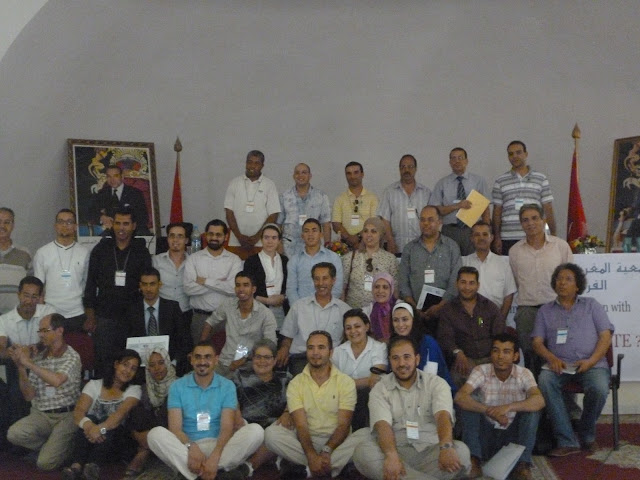
With the help of Native Moroccan teachers, like the ones below, I've gotten a solid base of Arabic. (and a few slang words too) I was able to attend the Moroccan Association of Teachers of English conference here to see first hand their dedication and training. This association works to provide multi lingual teachers across the country.
After 8 weeks of study I can say I have a firm grasp, though limited conversational vocabulary of the language. I can also write and recite the alphabet and its variations. For me this gave me a rush of excitement. Simple I know, but when first presented with the shapes, words and alphabet styles, it can seem like climbing a glacier without the harness, ice ax, and crampons. Just sliding down a slippery dangerous slope.
I've always said you need to be willing to look and sound like a fool to learn a language. This is no expception. I've had my moments. Sounding out slowly, each Arabic letter, with coordinating vowels, until.....bam!, you have a word. Like teaching a child C-A-T, k k k kaaattttt.....The final product is worth it! U7ibbo 3arabiya! Here is where to start:
غ ف ق ك ل
Getting through a paragraph of Arabic words, or writing if from dictation, always gives me a burst of exhilaration. I can do something that a couple of months ago, seemed completely foreign. I've reached my goal. Even with the extra bonus that Arabic letters, change their shape. This depends on if it is at the beginning of a word, middle or a word, end of the word, or isolated. In short the same letter can look a few different ways, and with your practice and studies, you are to distingush the shape depending on surrounding letters and their vowels. Practice, practice, practice, makes perfect.
For example: Here are 4 shapes for the K sound. (Kha)
The studies and the country have proven to keep me entertained. I'm continuing to learn, and seek out it's magic. This is only my experience. There is a very long history of Arabic throughout the Arab world, I encourage you to explore.
Enjoy and seek out your own journey. Whether you want to learn Arabic for your own interests, work, school or religion, delve in. There is a beauty in this language that is not really expressed in others. The daughter of one of the teachers below, did not hold back as she shared her opinions throughout lunch with us at the MATE conference. A great way to learn Arabic. Immersion. Real families. The catch? You get to enjoy the beauty of the authentic face and personality of kids like this.

If you're looking for studies in classic Arabic in Morocco, there are plenty of schools. I researched several in Fez, near Quarzazate, and Essouria, with many of them centered in the main cities of Fez and Rabat.There are of course, many unbelievable cities to study in, Egypt being another. The Egyptian Arabic is the most widely spoken dialect of this ancient language. Good luck!
If you're in Marrakech, the Visa School contact is Abderahim. He would be happy to show you around!
Here are a few options to review depending on your needs, and budget.if your interested:
http://www.alif-fes.com/
http://www.igomorocco.com/
http://www.qalamcenter.com/
http://www.speakmoroccan.com/
To most, outside of the Arab world, using alternative shapes in place of letters to read and write, seems about as appealing as communicating in mores code. My two cents? They are missing out.
The Arabic alphabet (Arabic: أَبْجَدِيَّة عَرَبِيَّة ’abjadiyyah ‘arabiyyah) or Arabic abjad is the Arabic script as it is codified for writing the Arabic language. It is written from right to left, in a cursive style, and includes 28 letters.(wikipedia) Plus several fun vowels and accents to determine where the sound is placed.

(July 20 to August 20) Ramadan continues, producing many more flags and banners around the city. Quotes of motivation and devotion for the sacred month. Such as the one above from the main sqaure.
I visited Marrakech to take a career break and focus on the study of Classic Arabic. With a connection I found the Visa school of Marrakech, located just off the main Avenue in the new city of Gueliz. They've proven to be flexible, friendly, and efficient.I couldnt have asked for more as I ventured into the unknown sounds and letters of Arabic. Why go to Morocco to study Arabic? It's a valid question, as in most day to day interactions in Morocco the main language of choice continues to be French (with a lot of French ex pats) and Derija, a local Mauracshi dialect.
I chose it because of a long fascination with the magical cities of Morocco. The stories of Kings, love stories, and ancient Berber and Bedouine tribes. (besides all that Casablanca movie stuff) Of course the spectacluar deserts and awaited camel rides and lots of heat, heat, heat appealed to me as well.

I love walking by this small shop in the sook, above. Wall to wall books of Arabic classics and studies. The small hand below, is the merchant ducking as a shot this photo. ;( Shukran Khohar, Shukran.
I chose to begin my Arabic studies classically (foos7a) with the Latin alphabet. Knowing myself, and my past learning of other languages, I felt it was best to get a solid base of vocabulary under my belt. A lot of people say this is the wrong way to do it. I can't vouch for them. For me, a solid ground of vocabulary, and Arabic verb conjugation, proved to aid me in my speed of reading and writing with the Arabic alphabet.
With the help of Native Moroccan teachers, like the ones below, I've gotten a solid base of Arabic. (and a few slang words too) I was able to attend the Moroccan Association of Teachers of English conference here to see first hand their dedication and training. This association works to provide multi lingual teachers across the country.

After 8 weeks of study I can say I have a firm grasp, though limited conversational vocabulary of the language. I can also write and recite the alphabet and its variations. For me this gave me a rush of excitement. Simple I know, but when first presented with the shapes, words and alphabet styles, it can seem like climbing a glacier without the harness, ice ax, and crampons. Just sliding down a slippery dangerous slope.
I've always said you need to be willing to look and sound like a fool to learn a language. This is no expception. I've had my moments. Sounding out slowly, each Arabic letter, with coordinating vowels, until.....bam!, you have a word. Like teaching a child C-A-T, k k k kaaattttt.....The final product is worth it! U7ibbo 3arabiya! Here is where to start:
| ا ب ت ث ج ح | م ن ه و ي | |||||||||||||||
| خ د ذ ر ز س | ش ص ض ط ظ ع |
غ ف ق ك ل
Getting through a paragraph of Arabic words, or writing if from dictation, always gives me a burst of exhilaration. I can do something that a couple of months ago, seemed completely foreign. I've reached my goal. Even with the extra bonus that Arabic letters, change their shape. This depends on if it is at the beginning of a word, middle or a word, end of the word, or isolated. In short the same letter can look a few different ways, and with your practice and studies, you are to distingush the shape depending on surrounding letters and their vowels. Practice, practice, practice, makes perfect.
For example: Here are 4 shapes for the K sound. (Kha)
| khā’ | kh (also ḫ, ḵ) | /x/ | ـخ | ـخـ | خـ | خ |
Enjoy and seek out your own journey. Whether you want to learn Arabic for your own interests, work, school or religion, delve in. There is a beauty in this language that is not really expressed in others. The daughter of one of the teachers below, did not hold back as she shared her opinions throughout lunch with us at the MATE conference. A great way to learn Arabic. Immersion. Real families. The catch? You get to enjoy the beauty of the authentic face and personality of kids like this.

If you're looking for studies in classic Arabic in Morocco, there are plenty of schools. I researched several in Fez, near Quarzazate, and Essouria, with many of them centered in the main cities of Fez and Rabat.There are of course, many unbelievable cities to study in, Egypt being another. The Egyptian Arabic is the most widely spoken dialect of this ancient language. Good luck!
If you're in Marrakech, the Visa School contact is Abderahim. He would be happy to show you around!
Here are a few options to review depending on your needs, and budget.if your interested:
http://www.alif-fes.com/
http://www.igomorocco.com/
http://www.qalamcenter.com/
http://www.speakmoroccan.com/

No comments:
Post a Comment